Last Updated: October 25, 2026
Quick Summary
Underground tank leak detection uses periodic measurement of product volume or tank tightness plus continuous monitoring of the spaces where a release would first appear. Federal rules under 40 CFR Part 280 require one of these tank leak detection methods at almost every regulated site, and secondary containment must hold released product until it is detected and removed.
- Automatic tank gauging runs a quiet-period test and alarms when the calculated leak rate crosses a threshold.
- Interstitial monitoring checks the annular space of double-walled tanks, where a release appears first.
- Report a suspected release to the implementing agency within 24 hours and confirm or deny it within seven days.
- Average active remediation costs run $255,491 per leaking UST site, far more than testing.
- Match the method to your tank configuration: a single-walled tank cannot use interstitial monitoring.
Table of Contents
- How Underground Storage Tank Leak Detection Actually Works
- UST Leak Detection Methods Compared
- How an Automatic Tank Gauging System Detects a Leak
- Tank Tightness Testing and Line Leak Detection
- Underground Storage Tank Leak Detection Requirements
- Choosing a Method by Tank Configuration and Site Conditions
- What to Do Immediately After a Suspected Leak
- Costs, False Alarms, and Lifecycle Considerations
- Request Dispatch for Your Compliance Testing
- Frequently Asked Questions
How Underground Storage Tank Leak Detection Actually Works
Underground storage tank leak detection is the set of monitoring and testing practices that confirm a tank, its piping, and its containment space are not releasing regulated substances into soil or groundwater. At USTEX LLC, we test tanks and lines across Wisconsin. The stakes are not abstract. One source reports average active remediation costs of $255,491 per leaking UST site, with more than 53,000 active cleanup sites nationally as of late 2025 (Interstitial Monitoring for Underground Storage Tanks). Detection is cheaper than cleanup by an order of magnitude.
Leak detection works through two mechanisms: periodic measurement of product volume or tank tightness, and continuous monitoring of the spaces where a release would first appear. Federal rules require one of these methods at almost every regulated site.
UST Leak Detection Methods Compared
Seven release-detection methods dominate practice today, and each fits a different tank configuration. The table below summarizes the trade-offs.
| Method | What It Detects | Best For | Main Limitation |
|---|---|---|---|
| Automatic tank gauging | Slow product loss | Most tanks with gauges | Misses small or fast losses |
| Statistical inventory reconciliation | Inventory trends | Sites with good records | Needs accurate data |
| Manual tank gauging | Gross loss | Small tanks only | Labor-intensive |
| Interstitial monitoring | Wall or liner breach | Double-walled tanks | Requires annular space access |
| Groundwater monitoring | Dissolved contamination | Sites with monitoring wells | Detects after migration |
| Vapor monitoring | Volatile vapors | Sites in soil-vapor pathways | Sensitive to site conditions |
| Line leak detection | Piping releases | Pressurized piping | Piping-specific only |
Methods of Leak Detection for Underground Storage Tanks lists automatic tank gauging, soil-vapor monitoring, and groundwater monitoring among the recognized approaches.
Automatic Tank Gauging and Inventory Monitoring
An automatic tank gauging system measures product level and temperature on a schedule, then calculates whether volume is falling faster than evaporation and sales explain. These systems run quiet tests when the tank is still, and they generate alarms when the calculated leak rate crosses a threshold. The weakness is discrimination: a gauge cannot always separate a genuine release from a faulty probe or a delivery discrepancy.
Statistical Inventory Reconciliation and Manual Gauging
Statistical inventory reconciliation compares daily product inventory against sales and deliveries over a rolling period, then applies statistical analysis to the variance. It works well for operators with disciplined recordkeeping. Manual tank gauging remains permitted for smaller tanks, but it demands consistent procedure and still cannot match continuous monitoring for early warning.
Interstitial, Groundwater, and Vapor Monitoring
Interstitial monitoring checks the annular space between a primary tank wall and secondary containment, which is where a release appears first on a double-walled system. Federal regulations require secondary containment to hold leaked regulated substances until they are detected and removed (40 CFR Part 280). Groundwater and vapor monitoring extend detection beyond the tank itself, sampling wells or soil gas for signs that petroleum products have migrated.
How an Automatic Tank Gauging System Detects a Leak
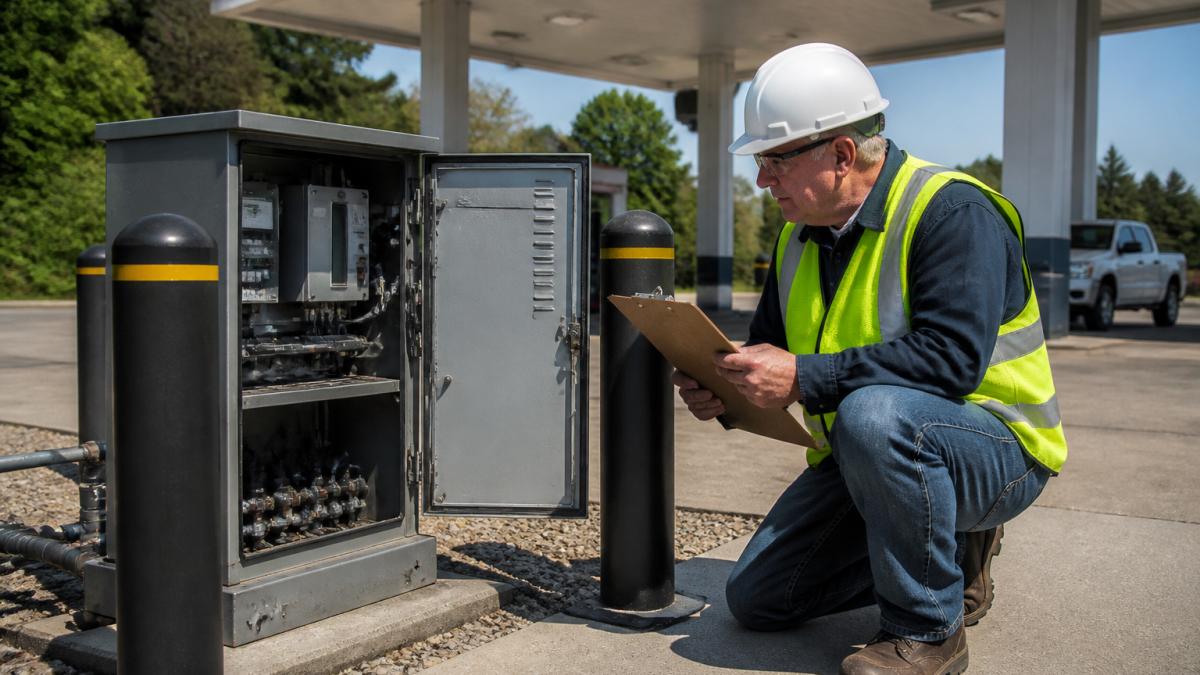
A tank gauge detects a leak by running a quiet-period test: it seals off sales activity, tracks product level and temperature for a set window, and calculates whether the loss rate exceeds the detection threshold. If it does, the console alarms and prints a test record.
The sequence matters more than the hardware:
- Stabilize the tank. Product must settle so temperature and level readings are not skewed by a recent delivery.
- Run the test. The gauge logs level and temperature at intervals across the test window.
- Calculate the leak rate. The system compares measured loss against the threshold and reports pass or fail.
- Review the record. A failed test needs a second test or a tightness test before anyone calls it a release.
A common mistake is treating a single failed test as confirmation. Gauges produce false alarms from probe drift and temperature swings, which is why the record review step exists.
Tank Tightness Testing and Line Leak Detection
Tank tightness testing isolates the tank and measures whether it holds vacuum or pressure over a defined period, which is a different question from what a gauge answers. Line leak detection covers pressurized piping, where a small release can move product fast.
The distinction trips people up constantly. A tank tightness test proves the tank shell is sound. A line tightness test proves the piping is sound. A line leak detector proves the detector itself works. Readers comparing approaches can compare tank, line, and leak detector tests to see which equipment each covers.
For sites with pressurized piping, annual mechanical and electronic line leak detector checks are typically part of the compliance calendar. Our team handles line tightness and detector testing as a standalone service.
Underground Storage Tank Leak Detection Requirements
Requirements come from two layers: federal rules that set the floor, and state programs that set the schedule and the paperwork. The EPA's underground storage tank research program documents decades of work on detection methods and leak-rate estimation, which is the technical foundation the rules rest on.
Federal Rules Under 40 CFR Part 280
Federal regulations require owners and operators of regulated tanks to use release detection that can detect a leak from any portion of the tank or piping, and to maintain records proving the method works. Secondary containment systems must hold released product until it is detected and removed. Tanks without release detection are out of compliance, full stop.
State and Local Schedules
Schedules are not uniform. A commercial inspection guide notes that most states require annual inspection and testing but that requirements can vary, so state-specific guidance must be checked rather than assuming one calendar fits every site (UST Leak Detection Testing: Inspection Guide). In Wisconsin, DATCP administers the tank program, and the report format a reviewing agency expects is part of compliance, not an afterthought. Once your obligations are clear, tank tightness testing with compliance documentation is the service that produces the record.
Choosing a Method by Tank Configuration and Site Conditions
Method selection starts with configuration, not preference, and it has to survive a side-by-side comparison on performance, not just on category. The matrix below is the one most operators never see: it puts detection threshold, testing period, and operational constraint next to each method so the trade-offs are visible.
| Method | Typical detection threshold | Testing period | Operational constraint |
|---|---|---|---|
| Automatic tank gauging (in-tank monitor) | Roughly 0.1-0.2 gallons per hour, depending on the certified test | Monthly test, or continuous with alarms | Needs a quiet period with no dispensing or delivery |
| Statistical inventory reconciliation | Depends on data quality; tighter with more history | Monthly or annual, per the method's certification | Requires disciplined daily inventory and delivery records |
| Manual tank gauging | Gross loss only; small tanks under the regulatory size cutoff | Weekly, with a monthly average | Labor-intensive; sensitive to reading technique |
| Interstitial monitoring | Detects a breach of the primary wall or liner | Continuous, or on a set schedule | Requires access to the annular space and a functioning sensor |
| Groundwater monitoring | Detects dissolved contamination, not the release itself | Quarterly or semiannual sampling | Needs monitoring wells in the right location and a clean baseline |
| Vapor monitoring | Detects volatile vapors in soil gas | Continuous or periodic, per the method | Sensitive to soil moisture, barometric pressure, and background vapors |
| Line leak detection (pressurized piping) | 3 gallons per hour for the annual test; tighter for periodic and continuous detectors | Annual, monthly, or continuous, by detector type | Piping-specific; says nothing about the tank shell |
Use the matrix with this decision path:
- Single-walled tank, no secondary containment: automatic tank gauging, statistical inventory reconciliation, or periodic tightness testing. Pick based on recordkeeping discipline, not hardware cost.
- Double-walled tank with interstitial space: interstitial monitoring, which catches a breach earliest. Pair it with tank gauging so the tank shell is also covered.
- Pressurized piping: line leak detection is mandatory in practice, not optional. The 3-gallon-per-hour annual test is the floor, not the ceiling.
- Sensitive groundwater or nearby wells: add groundwater or vapor monitoring to the primary method. Neither replaces tank or line detection; both extend the detection boundary.
- Small tank under the manual gauging threshold: manual tank gauging may be permitted, but document every reading and keep the monthly average current.
- Irregular operating schedule (seasonal, high-turnover, or delivery-heavy sites): favor continuous monitoring over periodic tests, because quiet-period tests are hard to schedule and easy to invalidate.
The method that fits beats the method that sounds most advanced. A site with a double-walled tank and interstitial sensors already has better protection than a single-walled tank with the newest gauge, and a site with clean inventory records often gets more from statistical reconciliation than from an upgraded console.
What to Do Immediately After a Suspected Leak
Suspected leaks follow a defined sequence, and the order protects you. The federal rules set the floor: owners and operators must report a suspected release to the implementing agency within 24 hours, and must confirm or deny the suspected release within seven days of the report or the observation that triggered it (40 CFR Part 280). State programs can shorten those clocks, so check the state schedule before you assume 24 hours is the deadline.
- Stop and secure. Suspend deliveries and dispensing if a release is plausible. Shut off the submersible pump if product is moving. Keep people away from the affected area and eliminate ignition sources.
- Contain what you can. Prevent product from reaching drains, soil, or surface water. Absorbent material and temporary berms buy time; they do not substitute for a qualified assessment.
- Run a confirming test. A failed gauge test or a positive monitoring well result needs verification before you report a release. A second test or a tightness test is the usual confirmation path, and the seven-day confirm-or-deny window is the clock you are working against.
- Notify the agency. Report to the implementing agency within the federal 24-hour window, and sooner if the state requires it. The report should identify the site, the tank and piping involved, the substance, the estimated quantity if known, and the corrective action taken so far.
- Document everything. Test records, alarm logs, inventory data, notification times, and names of agency contacts become the site investigation file. Keep the file in one place; a regulator will ask for it as a set, not as scattered printouts.
- Get a qualified assessment. Confirmation is not cleanup. A qualified assessor determines the extent of the release, whether it reached groundwater, and what corrective action the state will require.
A suspected release is not the same as a confirmed release, and the rules treat them differently. The 24-hour report starts the clock; the seven-day confirm-or-deny step is where a second test or a tightness test earns its keep. If your inventory does not reconcile or a monitoring well returned a positive result, our suspected leak investigation path covers the next steps.
Costs, False Alarms, and Lifecycle Considerations
Cleanup costs dwarf testing costs. The reported average of $255,491 per leaking site is the number to keep in front of you when a testing invoice feels expensive. False alarms carry their own cost: unnecessary tightness tests, disrupted sales, and eroded trust in the monitoring system. Probe calibration and disciplined record review cut false alarms more than any equipment upgrade.
Lifecycle planning matters too. Sensors age, gauges drift, and containment liners degrade. Budget for periodic verification rather than waiting for a red tag to force it. The cheapest program is a boring one: scheduled tests, clean records, and alarms investigated the first time.
Request Dispatch for Your Compliance Testing
The challenge is not knowing that detection matters. It is getting a test done fast, with documentation a regulator accepts the first time. USTEX LLC is a DATCP licensed specialty firm (#560989) providing independent testing with no competing claims on repair or construction work. You get direct access to founder Doug Metzker for testing and reporting, same-day documentation in the format reviewing agencies require, and priority scheduling for red-tagged sites. Request dispatch for your compliance testing and get your site back to operational readiness.
Frequently Asked Questions
How does underground storage tank leak detection work?
Detection relies on comparing what goes in, what comes out, and what stays in the tank. Automatic tank gauging measures product level and temperature to calculate a leak rate; statistical inventory reconciliation analyzes daily inventory records; interstitial monitoring checks the space between a primary tank and secondary containment; and tank tightness testing isolates the tank for a controlled measurement. Most sites combine methods rather than relying on one, because each has a detection threshold and a monitoring frequency set by federal rules under 40 CFR Part 280.
What are the main UST leak detection methods?
The common methods are automatic tank gauging, statistical inventory reconciliation, manual tank gauging at smaller capacities, interstitial monitoring, groundwater monitoring, vapor monitoring, and line leak detection for pressurized piping. Tank tightness testing serves as a periodic precision check. Which combination applies depends on tank size, piping type, whether secondary containment is installed, and site hydrogeology. A method that works on a double-walled tank with interstitial sensors may not suit a single-wall tank with no monitoring wells.
How often should an underground storage tank be tested for leaks?
Federal rules require release detection on an ongoing basis, with methods run at defined intervals such as monthly monitoring or annual tightness testing depending on the method and equipment. Many states add their own inspection and testing schedules, and a commercial inspection guide notes that most states require annual inspection and testing but that requirements vary. Confirm the schedule with your state regulator rather than assuming one calendar fits every site.
What should you do if an underground storage tank leak is suspected?
Stop dispensing from the suspect tank, keep people away from the area, and report to the state regulatory agency within the timeframe your state sets. Federal rules under 40 CFR Part 280 require owners and operators to report suspected releases, investigate, and confirm or rule out a leak. Document gauge readings, inventory records, and any odor or sheen observed. Then arrange independent confirmation testing so the report you send the regulator is measured data, not an estimate.
Can a leak detection system produce false alarms?
Yes. Automatic tank gauging can flag a leak when product level shifts for reasons other than a release, such as temperature change, a delivery in progress, water intrusion, or a faulty probe. That is why confirmation matters: a failed test result should be checked with a second method or a tightness test before anyone concludes the tank is leaking. False alarms are also why raw data appended to a report is useful, since the reviewing agency can see what the instrument actually recorded.
How do automatic tank gauging systems detect leaks?
An automatic tank gauging system measures product level and temperature in the tank, often over a quiet period when no dispensing or delivery is happening, and calculates whether the level is falling faster than the method's detection threshold allows. Many systems also monitor interstitial spaces and piping. The output is a pass or fail result plus the underlying readings. Keep those records: they are the evidence a regulator reviews when a site is red-tagged or a permit renewal is under review.
