Last Updated: October 26, 2026
Quick Summary
Aboveground storage tank integrity testing checks the shell, bottom, welds, and piping for corrosion, leaks, and structural weakness so you can prove the tank is fit to keep holding fuel. The SPCC rule requires it for aboveground bulk storage containers at onshore facilities, except oil production facilities.
- SPCC applies at 1,320 U.S. gallons or more in containers of 55 gallons or greater.
- Monthly visual checks look for leaks, stains, and damaged containment.
- STI SP001 covers shop-built tanks and smaller field-erected tanks.
- API 653 applies to larger welded steel tanks, typically field-erected.
- A report should include raw measurements, photos, and a stated conclusion on continued use.
Table of Contents
- What Aboveground Storage Tank Integrity Testing Covers
- Aboveground Storage Tank Inspection Requirements Under SPCC
- STI SP001 Tank Inspection and How to Choose a Standard
- Your Aboveground Storage Tank Inspection Checklist
- What an Aboveground Tank Inspection Report Should Contain
- Request Dispatch for Same-Day Testing Documentation
- Frequently Asked Questions
What Aboveground Storage Tank Integrity Testing Covers
Aboveground storage tank integrity testing is the process of checking a tank's shell, bottom, welds, and piping for corrosion, leaks, and structural weakness so the owner can prove the tank is fit to keep holding fuel. The EPA's SPCC bulk storage container guidance states that integrity testing is required for aboveground bulk storage containers at onshore facilities, except oil production facilities.
A test covers more than the tank itself. It reaches the parts that fail quietly:
- Tank shell and bottom plate, checked for corrosion and wall loss
- Welds and seams, checked for cracks
- Piping, flanges, and valves
- Secondary containment and spill buckets
- Overfill protection and leak detection equipment
Miss one of those and the report looks clean while the site stays exposed. If you want to see the full scope of what USTEX LLC tests, review their aboveground storage tank testing service.
Federal SPCC Applicability and Who Must Test
The SPCC rule applies to facilities with aboveground oil storage capacity of 1,320 U.S. gallons or more in containers of 55 gallons or greater, according to the EPA tank inspection page. Below that threshold, state rules can still apply. Wisconsin operators answer to DATCP on top of the federal requirements.
Aboveground Storage Tank Inspection Requirements Under SPCC
SPCC requirements split into two duties: inspect the tank regularly and test its integrity on a schedule. Visual inspection catches what you can see. Integrity testing catches what you cannot.
Monthly visual checks look for leaks, stains, and damaged containment. Formal integrity testing uses non-destructive methods to measure wall thickness and find hidden defects. Both belong in the same file, and both get reviewed during a site inspection.
If you are weighing which methods your site needs, compare USTEX LLC's storage tank testing services to see the full list.
Integrity Testing Methods Compared
No single method finds everything. Most sites need a mix.
| Method | What It Finds | Disrupts Service? | Best For |
|---|---|---|---|
| Visual inspection | Leaks, corrosion, damage | No | Monthly checks |
| Ultrasonic testing | Wall thickness loss | No | Steel tank shells |
| Acoustic emission | Active defects in nonmetallic tanks | No | Fiberglass tanks |
| Leak testing | Actual product loss | Sometimes | Piping and tank systems |
Acoustic emission testing suits fiberglass-reinforced plastic tanks, where ultrasonic readings are harder to trust. A 2024 case study from Inspectioneering on non-intrusive tank assessments describes acoustic-emission testing on an FRP storage tank, though it reports no measured outcome. That is the honest state of the evidence: the method works, but published numbers are thin.
STI SP001 Tank Inspection and How to Choose a Standard
Choosing a standard comes down to tank type, size, construction, and what your regulator expects. The three standards you will encounter most often are STI SP001, API 653, and, less commonly in the United States, EEMUA 159. They are not interchangeable, and picking the wrong one can mean a report your reviewing agency will not accept.
What Each Standard Covers
STI SP001 is published by the Steel Tank Institute and covers shop-built tanks and smaller field-erected tanks. It is written for the tanks most commonly found at convenience stores, fleet yards, and small industrial sites. SP001 sets out inspection categories, intervals, and criteria for determining whether a tank is suitable for continued service. It relies heavily on external, non-intrusive inspection and allows a trained owner or operator to perform portions of the program.
API 653 is the American Petroleum Institute standard for tank inspection, repair, alteration, and reconstruction. It applies to larger welded steel tanks, typically field-erected, and it is more prescriptive about internal inspection, thickness measurements, and fitness-for-service evaluation. API 653 assumes a higher level of inspector qualification and produces a more detailed engineering record.
EEMUA 159 is a European publication for aboveground flat-bottomed tanks. Some U.S. operators with international parent companies or specific insurer requirements use it, but it is not a substitute for a standard your state or federal regulator has adopted.
A Practical Decision Guide
Ask these questions in order before you commit to a standard:
- What is the tank's size and construction? Shop-built and smaller field-erected tanks generally fall under SP001. Large field-erected welded steel tanks generally fall under API 653.
- Which standard does your reviewing agency accept? This is the controlling question. A standard that satisfies your insurer but not your state regulator does not close the file.
- Does the standard require internal inspection, or will external methods satisfy it? API 653 is more likely to require internal inspection or a documented equivalent. SP001 is built around external methods for many tank categories.
- What does your SPCC plan commit you to? The plan is the document an inspector reads first. If it names a standard or interval, you need to meet it or amend the plan.
- What is your inspection history? A tank with a clean history and stable product may qualify for a longer interval under either standard. A tank with prior repairs or unexplained loss will not.
Where Operators Get This Wrong
The most common error is assuming that because a tank is small, any inspection will do. A second common error is applying API 653 criteria to a shop-built tank and generating a report that overstates the required work. Neither mistake is cheap. The right standard is the one your regulator accepts, applied by an inspector who can document the measurements and the conclusion.
USTEX LLC's tank testing guides cover preparation, tightness testing, and the records your reviewing agency expects.
Your Aboveground Storage Tank Inspection Checklist
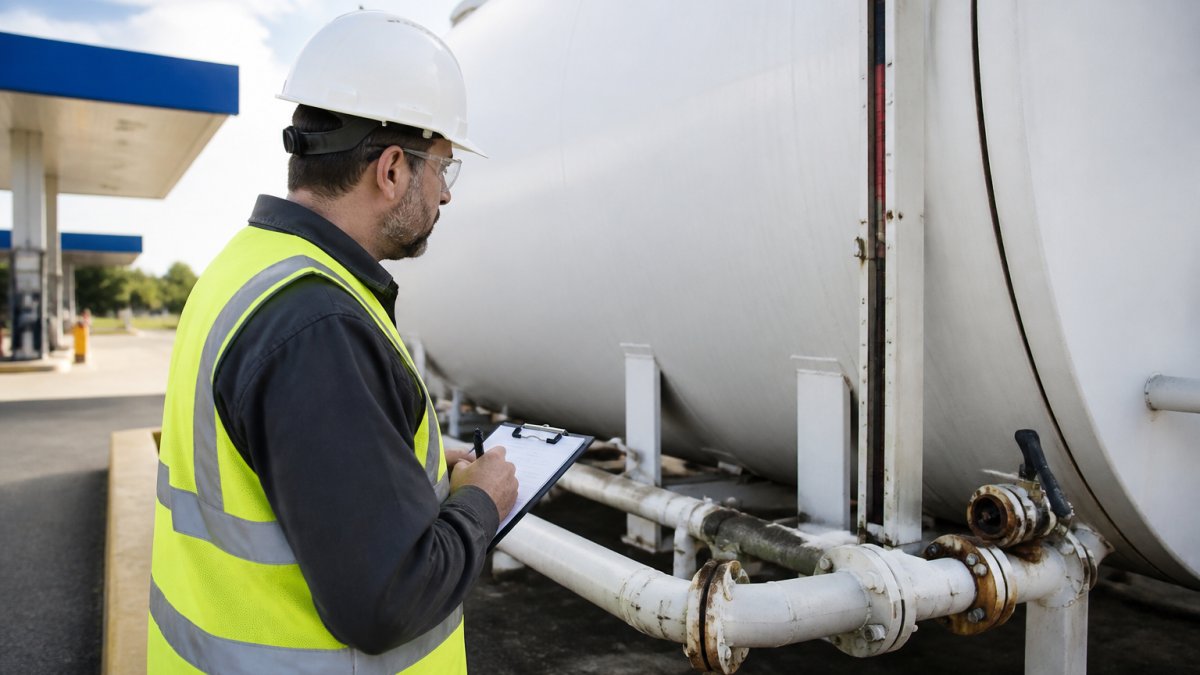
Use this checklist to prepare before the inspector arrives. A prepared site finishes faster and produces fewer surprises.
- Gather prior test reports and the current SPCC plan
- Confirm tank capacity and container sizes
- Clear access to the tank shell and piping
- Check secondary containment for standing liquid
- Verify overfill alarms and gauges work
- Note any stains, odors, or unexplained product loss
- Confirm spill buckets drain and seal
- List all appurtenances, including vents and flame arrestors
A common mistake is treating the checklist as paperwork.
What an Aboveground Tank Inspection Report Should Contain
An aboveground tank inspection report should state the method used, the measurements taken, the findings, and a clear conclusion about continued service. Anything less leaves your compliance file open to challenge.
A report worth filing includes:
- Tank and equipment identification
- Test method and standard applied
- Raw measurements, not just pass or fail
- Photographs of defects
- A stated conclusion on suitability for continued use
- Recommended corrective actions, ranked by urgency
Request Dispatch for Same-Day Testing Documentation
Red-tagged sites lose money every day the pumps stay down. We schedule those first. USTEX LLC is a DATCP licensed specialty firm (#560989), and we test independently, with no repair or construction work to sell you afterward.
Doug Metzker handles every test and report himself. Results come back same-day, formatted the way reviewing agencies expect.
Frequently Asked Questions
What does aboveground storage tank integrity testing include?
It covers a visual external inspection of the tank shell, bottom, welds, and appurtenances, plus non-destructive testing such as ultrasonic wall-thickness readings where the standard calls for them. Leak testing and secondary containment checks are often part of the scope. The EPA requires integrity testing for aboveground bulk storage containers at onshore facilities, except oil production facilities. The final deliverable is a condition assessment and inspection report that documents findings and any corrective action needed.
What is the difference between STI SP001 and API 653?
STI SP001 provides inspection and evaluation criteria for continued-service suitability and is commonly applied to smaller shop-fabricated tanks and bulk storage containers. API 653 is written for larger welded steel tanks and covers inspection, repair, alteration, and reconstruction in more depth. The right choice depends on tank size, construction, and service. Your qualified inspector should document which standard governed the inspection so the report holds up with regulators.
How often should an aboveground storage tank be inspected?
There is no single federal interval. The EPA requires integrity testing for applicable containers but the SPCC rule does not set one nationwide frequency. Many owners pair monthly visual checks with formal inspections on a schedule set by the applicable standard and the tank's condition. Confirm the interval with your state agency and your inspector.
Can an aboveground storage tank be inspected while it is in service?
Often yes. Non-intrusive methods such as acoustic-emission testing allow assessment of nonmetallic tanks without taking them out of service, and a 2024 Inspectioneering case study describes this approach on a fiberglass-reinforced plastic tank. External visual inspection is also done in service. Internal inspection and some leak tests require the tank to be emptied and cleaned. Ask your provider which methods apply to your tank so you can plan downtime around them.
Facing a red tag or a permit renewal deadline? USTEX LLC provides independent testing with raw data appended to every report, priority scheduling for red-tagged sites, and direct access to the founder for all testing and reporting. Get started with USTEX LLC and request dispatch for your site.
