Quick Summary
Wisconsin underground storage tank compliance requires registering tanks with the Department of Agriculture, Trade and Consumer Protection (DATCP), obtaining plan review before installations or major changes, and keeping corrosion protection, leak detection, and operator training current. Federal EPA rules set the baseline, and owners must meet the stricter requirement where both apply.
- Register tanks containing regulated substances with DATCP, including temporarily out-of-service tanks.
- Submit a complete plan review package before installing, replacing, or modifying tanks or piping.
- Protect steel tanks with coatings, cathodic protection, or fiberglass construction, and document their testing.
- Keep dated, signed test reports for cathodic protection, release detection, and lining inspections.
- Track registration, testing, training, and financial responsibility renewals on a single compliance calendar.
Table of Contents
- How Wisconsin and Federal UST Rules Divide Responsibility
- Registering Your Tanks With DATCP
- Wisconsin Storage Tank Plan Review Process
- Installation, Upgrade, and Underground Storage Tank Corrosion Prevention
- UST Leak Detection Methods and Monitoring Schedules
- Operator Training, Spill and Overfill Prevention, and Financial Responsibility
- Compliance Deadlines, Recordkeeping, and Inspection Schedules
- Scheduling Your Compliance Testing and Requesting Dispatch
- Frequently Asked Questions
How Wisconsin and Federal UST Rules Divide Responsibility
Last Updated: October 30, 2026
Wisconsin underground storage tank compliance requirements sit on two layers of law, and the layers do not always match. Federal rules set the floor, and the state builds its own program on top. Owners who assume one rulebook covers everything often find out the hard way that they are missing a filing. Wisconsin DATCP petroleum and hazardous substance storage tank program overview
At USTEX LLC, we work with fuel retailers, fleet yards, and municipal sites across Wisconsin, and the confusion shows up on nearly every first call. The federal framework comes from the EPA, and state rules build on it. Confirm the current state and federal requirements that apply to your site before you plan any work.
Which Agency Has Jurisdiction Over Your Tanks
Jurisdiction is the first question to settle. For Wisconsin tank owners, the Department of Agriculture, Trade and Consumer Protection (DATCP) is a primary agency for storage tank registration and compliance activity. The EPA remains a federal source of baseline rules.
In practice, this means you answer to the state for registration and routine compliance, and you may still see federal expectations in the background. A useful rule: if a question concerns paperwork, registration status, or an operator's obligations, start with DATCP. If it concerns a federal rule the state has not separately adopted, check the EPA's current requirements.
Applicability by Tank Type, Use, and Exemption
Not every tank falls under the same obligations. Whether a tank falls under the core UST rules depends on its capacity and other factors, so confirm applicability for each tank. Capacity is only the first filter, though. The tank's contents, whether it is in use or temporarily out of service, and whether it is residential or commercial all change what you have to do.
Residential heating oil tanks deserve attention because a tank that is no longer working properly can still create a leak risk.
Facility size matters too. Spill Prevention, Control, and Countermeasure (SPCC) plans may apply to larger facilities, so check the applicable federal threshold for your site.
Registering Your Tanks With DATCP
Registration is the step that most often gets missed during a change in ownership or a new installation. Tanks containing a regulated substance must be registered with DATCP within the deadline that applies to their status, so confirm the current registration window with DATCP.
Gather the basics before you file: the tank's capacity, contents, installation date, and current operating status. A tank that has been taken out of service temporarily still needs to be on the books, which is a detail that catches owners who think "out of service" means "off the hook." Keeping a running inventory of every tank on the property makes registration far less painful during an audit.
The same principle applies to the company behind the tanks. Registration records should match the entity that actually owns and operates the system, so a sale or a change in operator is a moment to re-check your filings rather than assume they carried over.
Wisconsin Storage Tank Plan Review Process
Plan review is the stage where DATCP checks a proposed installation or major modification before work proceeds. If you are planning a new system, a replacement, or a significant change to piping and dispensing, expect the design to be reviewed against state requirements before construction begins. Starting this review late is one of the most common causes of delayed projects.
What Triggers Plan Review
Plan review is not limited to brand-new tanks. Common triggers include:
- Installing a new UST or replacing an existing tank
- Adding or replacing piping, dispensers, or sumps
- Changing the product stored (for example, switching from gasoline to diesel or to a hazardous substance)
- Adding or upgrading release detection, spill prevention, or overfill prevention equipment
- Converting a tank to a different use or bringing a temporarily out-of-service tank back into service
A common pattern is for owners to treat a piping swap as routine maintenance. If the change affects containment, release detection, or the tank's regulated status, assume plan review applies until DATCP confirms otherwise.
What the Submittal Package Should Contain
A complete package shortens review time. The following items are commonly requested with a submittal package:
- Tank and piping specifications, including materials, capacity, and construction (single-wall versus double-wall)
- A site plan showing tank location, piping runs, dispensers, and setback distances
- The release detection method and how it will be installed and tested
- Spill prevention and overfill prevention equipment, with model numbers and set points
- Corrosion protection design for steel components (coating, cathodic protection, or both)
- The intended product and any associated hazard classification
- Owner and operator identification matching the registration record
Missing details come back as requests for additional information, which adds weeks to the schedule. Submitting a complete package the first time shortens the path to approval considerably.
How Review Fits the Project Schedule
Treat plan review as a milestone in the project schedule, not a formality at the end. Builders who wait until the tank is set to ask about approval are the ones who end up paying for excavation and rework. A practical sequence is:
- Confirm applicability and gather design documents.
- Submit the plan review package and track the review status.
- Resolve any requests for information before mobilizing equipment.
- Complete installation and notify DATCP as required.
- Register or update the tank record within the required window after the status change.
Wisconsin DATCP storage tank plan review and forms
Where Federal Rules Enter the Picture
Because the state does not hold formal state program approval from the EPA, the state rules are the ones you will be inspected against day to day, but the federal framework still sets the floor. If a design element is addressed by both, meet the stricter requirement. If a question concerns a federal rule the state has not separately adopted, check the EPA's current requirements before you build.
Installation, Upgrade, and Underground Storage Tank Corrosion Prevention
Corrosion is the long-term threat to any buried steel tank, and the protection you choose at installation largely determines how long the system lasts. Corrosion protection is a design decision, so it belongs in the plan review package rather than in an afterthought once the tank is in the ground.
The Three Corrosion Protection Mechanisms
Corrosion protection for steel tanks and piping generally falls into a few recognized approaches:
- Coating or lining. A protective coating or interior lining isolates steel from the product and soil. Coatings must be inspected for holidays and damage before backfill.
- Cathodic protection. Impressed-current or sacrificial-anode systems shift the electrochemical reaction away from the steel. These systems require periodic testing to confirm they are still working.
- Fiberglass-reinforced plastic (FRP) construction. Non-metallic tanks and piping are inherently corrosion-resistant and do not require cathodic protection.
A common pattern is for older sites to have coated steel tanks with no cathodic protection, or cathodic protection that was installed but never tested. Both are upgrade candidates.
What Upgrades Typically Involve
Upgrades are where older sites run into trouble. Tanks and piping installed before the revised federal requirements may lack the corrosion protection or overfill features now expected. An upgrade is not always a full replacement; in many cases, targeted work on piping, sumps, and fill connections closes the gap. Typical upgrade scopes include:
- Adding or restoring cathodic protection on steel tanks and piping
- Replacing single-wall piping with double-wall piping and interstitial monitoring
- Upgrading spill buckets and overfill prevention devices to current standards
- Adding sump liners or replacing damaged sumps
- Installing or repairing release detection equipment
Inspection and Testing Intervals
Corrosion protection is only effective if it is verified. Most practitioners find the following intervals are expected:
- Cathodic protection testing: test on the schedule required for your system and method.
- Internal lining inspection: follow the schedule set by the lining manufacturer and the applicable requirements.
- Release detection equipment testing: test release detection equipment on the schedule its requirements specify.
- Spill and overfill equipment: checked at each delivery and tested on a defined schedule.
Recordkeeping for Corrosion Protection
Keep the following records together and easy to produce:
- Cathodic protection test results, including the tester's name and date
- Lining inspection reports and manufacturer warranties
- Installation records for coatings, linings, and anodes
- Repair records for any piping, sump, or tank work
- Correspondence with DATCP regarding plan review and approvals
Lifecycle Checklist for Installation and Upgrades
Use this checklist to organize the work from design through ongoing operation:
- Design: confirm applicability, select corrosion protection, and prepare the plan review package.
- Approval: submit to DATCP and resolve requests for information before mobilizing.
- Installation: verify coatings, linings, and anodes are installed per specification and documented.
- Registration: update the tank record within the required window after the status change.
- Operation: test cathodic protection and release detection on schedule and keep the reports.
- Upgrade: assess older tanks against current requirements and scope targeted work before a failure forces it.
EPA underground storage tank corrosion protection guidance
UST Leak Detection Methods and Monitoring Schedules
Leak detection is the core of ongoing compliance. Leaks are uncommon, but the monitoring program exists for the rare failure that goes unnoticed.
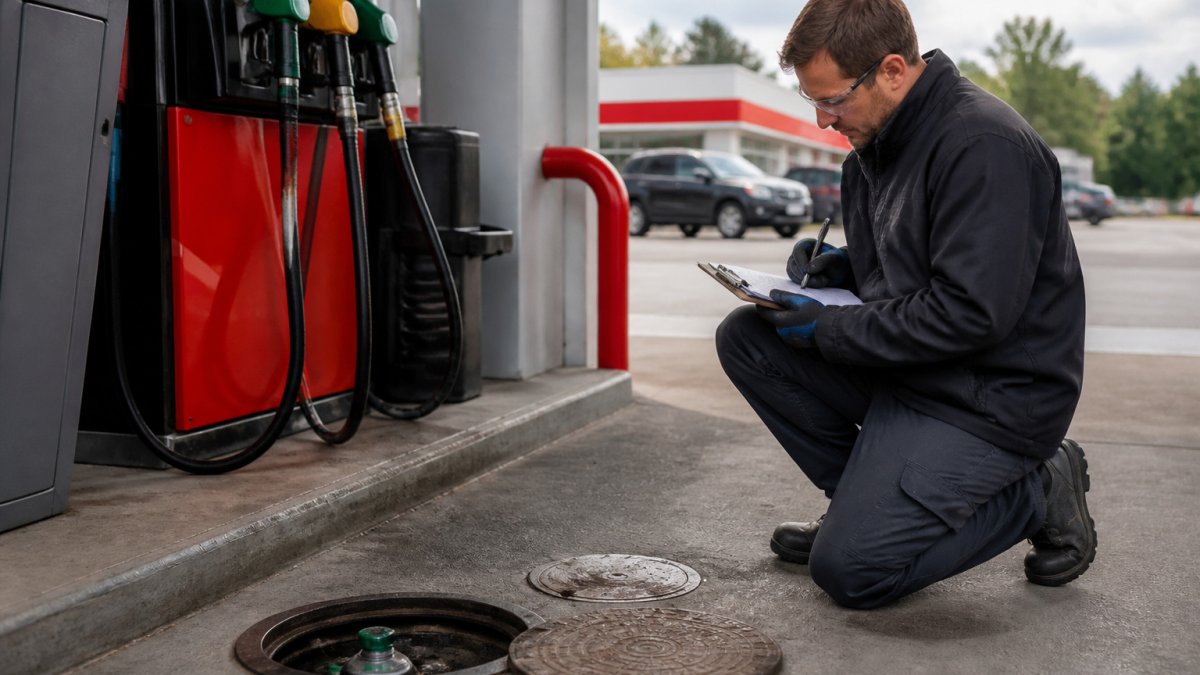
!A technician in a work jacket and gloves inspecting a fuel dispensing area beside a gas station, with a clipboard in hand
Common methods include automatic tank gauging, interstitial monitoring for double-walled systems, and periodic tightness testing. Each method suits different tank configurations, and the right choice depends on the system's age, construction, and how it is operated. Your monitoring schedule should be written down, assigned to a named person, and matched to the frequency your system requires.
Tightness testing and leak detector testing are different tests that cover different equipment. Keep both on the schedule, and keep the reports, because the reports are what an inspector will ask to see first.
Operator Training, Spill and Overfill Prevention, and Financial Responsibility
Operator training is a compliance requirement that many small sites overlook because the person filling the tank is already busy running the store. Trained operators recognize alarms, respond correctly to a suspected release, and know when to call for help. Keep training records current and tie them to each person who works the fuel island.
Spill and overfill prevention address the two most common routes by which product gets into the environment during deliveries and dispensing. Spill buckets, overfill alarms, and automatic shutoff devices each play a role, and each needs regular checks to confirm it still works. A device that has been disconnected or ignored offers no protection at all.
Financial responsibility is the requirement that you can pay for cleanup if a release happens. Owners typically satisfy it through insurance or another approved mechanism, and coverage must remain in force. A lapse in coverage can put you out of compliance even when your tanks are in perfect condition, so confirm the renewal date alongside your other deadlines.
Compliance Deadlines, Recordkeeping, and Inspection Schedules
Most compliance failures trace back to a missed date rather than a technical defect. Build a single calendar that holds registration deadlines, leak detection testing dates, operator training renewals, financial responsibility renewals, and any scheduled inspections. Assign each item an owner and a reminder well before it comes due.
Recordkeeping is what proves you did the work. Keep test results, repair records, training certificates, and correspondence with the agency together and easy to produce. The strongest records are dated, signed, and specific about what was tested and what the result was. Vague notes like "checked, fine" rarely satisfy a reviewing official.
Inspections happen on the state's schedule, not yours. Walk through your site periodically with the checklist an inspector would use, and fix small problems before they become violations. Owners who treat inspection readiness as a routine habit spend far less time scrambling when the notice arrives.
Most compliance failures come from missed dates, so the article's core obligations are easiest to track side by side.
| Obligation | Owner action | Timing or record |
|---|---|---|
| Tank registration | Register with DATCP | Within the deadline for status; out-of-service tanks still count |
| Leak detection testing | Test on schedule | Keep dated, signed reports |
| Operator training | Train each fuel-island operator | Keep training records current |
| Financial responsibility | Keep coverage in force | Track renewal date |
| Spill and overfill devices | Check and test regularly | Devices must work; disconnected ones offer no protection |
| Inspections | Self-inspect periodically | Fix small problems before notices arrive |
Scheduling Your Compliance Testing and Requesting Dispatch
When a site is red-tagged or a permit renewal is coming due, the fastest path is a prepared request. Gather the facility details, previous reports, equipment information, and access and delivery schedule before you call. A clear package lets a testing visit start on the first day rather than the second.
USTEX LLC performs independent underground and aboveground storage tank testing across Wisconsin, and our founder, Doug Metzker, handles testing and reporting directly. We do not perform repair or construction work. Reports are produced same-day in the format reviewing agencies expect, with raw data appended.
For sites losing revenue while pumps are down, priority scheduling for red-tagged locations is available. Request dispatch from USTEX LLC at (414) 301-3645.
Frequently Asked Questions
Do I need to register a tank that is temporarily out of service? Yes. In-use and temporarily out-of-service tanks containing regulated substances must be registered with DATCP within 15 business days of the status change. Being out of service does not remove the tank from the registration requirement.
Are residential heating oil tanks regulated? Residential heating oil tanks are treated differently from commercial systems. There is no federal or state law requiring removal of a properly functioning, active residential heating oil tank, though a failing tank still carries leak risk worth addressing.
Which agency handles Wisconsin storage tank registration? The Wisconsin Department of Agriculture, Trade and Consumer Protection (DATCP) administers storage tank registration, permitting, and routine compliance activity for most tank owners in the state.
When does a facility need an SPCC plan? Spill Prevention, Control, and Countermeasure (SPCC) plans are required for facilities with at least 42,000 gallons of total UST capacity under federal rules.
Frequently Asked Questions
What are the DATCP requirements for underground storage tanks?
The Wisconsin Department of Agriculture, Trade and Consumer Protection (DATCP) regulates underground storage tanks. Tanks containing regulated substances generally must be registered, operated with approved release detection, protected against corrosion, and maintained with accurate records. Owners should confirm the current registration deadlines for in-use and temporarily out-of-service tanks with DATCP. Owners should confirm current requirements directly with DATCP because rules and forms are updated periodically.
How often must underground storage tanks be inspected in Wisconsin?
Inspection and testing frequency depends on the tank system, the release detection method in use, and the specific requirements that apply to the facility. Wisconsin operators must perform routine and periodic compliance activities, and DATCP publishes a compliance calendar for owners and operators each year. Keep records of every test and inspection, because agencies typically review documentation first when evaluating a site. For a specific schedule, contact USTEX LLC or review your facility's requirements with DATCP.
What is the role of a DATCP-licensed contractor in UST compliance?
A DATCP-licensed specialty firm performs regulated tank work and produces documentation that reviewing agencies accept. USTEX LLC is a DATCP licensed specialty firm (#560989) that provides independent testing with no competing claims on repair or construction work. Independent testing helps avoid conflicts of interest and gives owners raw data they can submit with their records.
How do I renew my underground storage tank permit?
Permit and registration steps are handled through DATCP, and renewal documentation usually includes current tank registration information and proof of compliant testing. Gather your tank inventory, recent test results, and any open corrosion or release detection items before you submit. Confirm the current forms, fees, and deadlines with DATCP, since requirements change over time. Pricing for testing depends on tank count, site access, and scheduling, so request a quote from USTEX LLC for current figures.
What are the financial responsibility requirements for UST owners?
Owners of regulated underground storage tanks must maintain financial responsibility to cover cleanup and third-party liability if a release occurs. Coverage options can include insurance, a risk retention group, or other approved mechanisms, and coverage must remain in force. Verify current requirements with DATCP and your insurance provider, because the acceptable mechanisms and amounts depend on the size of your operation.
What happens if my facility receives a red-tag for UST non-compliance?
A red tag can halt fuel deliveries and dispensing until the deficiency is corrected and documented, which often means lost revenue every day the pumps are down. The fastest path to resolution is prompt, accurate testing with regulator-ready documentation submitted to the reviewing agency. USTEX LLC prioritizes red-tagged sites and provides same-day documentation in the format agencies require. Request dispatch through USTEX LLC to start the process.
